Performance Benchmark Report
Last updated: 05/14/2026
This report documents the performance benchmark results for Ray-Ascend's core data transport capabilities, focusing on post-training RL sample transmission and training- inference weight synchronization.
Test Environment
Hardware
| Component | Specification |
|---|---|
| NPU Model | Ascend 910B |
| Node Count | 2 nodes |
Software
| Component | Version |
|---|---|
| CANN | 8.3.RC1 |
| Ray | 2.55.1 |
| Ray-Ascend | 0.1.0 |
| Python | 3.10.16 |
1. RL Samples Transmission
This benchmark compares the performance of Yuanrong Direct Transport against Ray's default serialization for NPU tensor transmission in post-training RL scenarios.
1.1 Local Mode
Sender and receiver actors are colocated on the same node, utilizing local memory transfer.
1.1.1 Configuration
1.1.2 Results
Throughput Comparison
| Setting | Tensor Count | Tensor Size (KB) | Total Size (GB) | Transport Mode | AVG Throughput (Gbps) |
|---|---|---|---|---|---|
| small | 9216 | 32 | 0.28 | yr | 0.35 |
| small | 9216 | 32 | 0.28 | ray | 0.19 |
| medium | 61440 | 128 | 7.50 | yr | 1.25 |
| medium | 61440 | 128 | 7.50 | ray | 0.42 |
| large | 35000 | 384 | 12.81 | yr | 4.27 |
| large | 35000 | 384 | 12.81 | ray | 0.70 |
Latency Comparison
| Setting | Tensor Count | Tensor Size (KB) | Total Size (GB) | Transport Mode | P90 Latency (s) | P95 Latency (s) | P99 Latency (s) |
|---|---|---|---|---|---|---|---|
| small | 9216 | 32 | 0.28 | yr | 7.10 | 7.30 | 7.33 |
| small | 9216 | 32 | 0.28 | ray | 12.14 | 12.15 | 12.27 |
| medium | 61440 | 128 | 7.50 | yr | 48.99 | 49.09 | 49.17 |
| medium | 61440 | 128 | 7.50 | ray | 144.05 | 144.54 | 152.03 |
| large | 35000 | 384 | 12.81 | yr | 24.38 | 24.46 | 24.76 |
| large | 35000 | 384 | 12.81 | ray | 148.14 | 148.90 | 149.16 |
1.2 Remote Mode
Sender and receiver actors are distributed across two nodes, testing cross-node transport performance.
1.2.1 Configuration
backend: yr
init_mode: metastore
placement: remote
head_node_ip: "10.170.27.237"
worker_node_ip: "10.170.27.158"
device: npu
warmup_times: 5
count: 20
1.2.2 Results
Throughput Comparison
| Setting | Tensor Count | Tensor Size (KB) | Total Size (GB) | Transport Mode | AVG Throughput (Gbps) |
|---|---|---|---|---|---|
| small | 9216 | 32 | 0.28 | yr | 0.27 |
| small | 9216 | 32 | 0.28 | ray | 0.19 |
| medium | 61440 | 128 | 7.50 | yr | 1.11 |
| medium | 61440 | 128 | 7.50 | ray | 0.47 |
| large | 35000 | 384 | 12.81 | yr | 3.48 |
| large | 35000 | 384 | 12.81 | ray | 0.76 |
Latency Comparison
| Setting | Tensor Count | Tensor Size (KB) | Total Size (GB) | Transport Mode | P90 Latency (s) | P95 Latency (s) | P99 Latency (s) |
|---|---|---|---|---|---|---|---|
| small | 9216 | 32 | 0.28 | yr | 8.76 | 9.02 | 9.25 |
| small | 9216 | 32 | 0.28 | ray | 12.05 | 12.10 | 12.14 |
| medium | 61440 | 128 | 7.50 | yr | 54.97 | 55.15 | 55.22 |
| medium | 61440 | 128 | 7.50 | ray | 128.63 | 129.16 | 129.54 |
| large | 35000 | 384 | 12.81 | yr | 29.98 | 30.14 | 30.18 |
| large | 35000 | 384 | 12.81 | ray | 135.85 | 136.74 | 138.81 |
1.3 Analysis
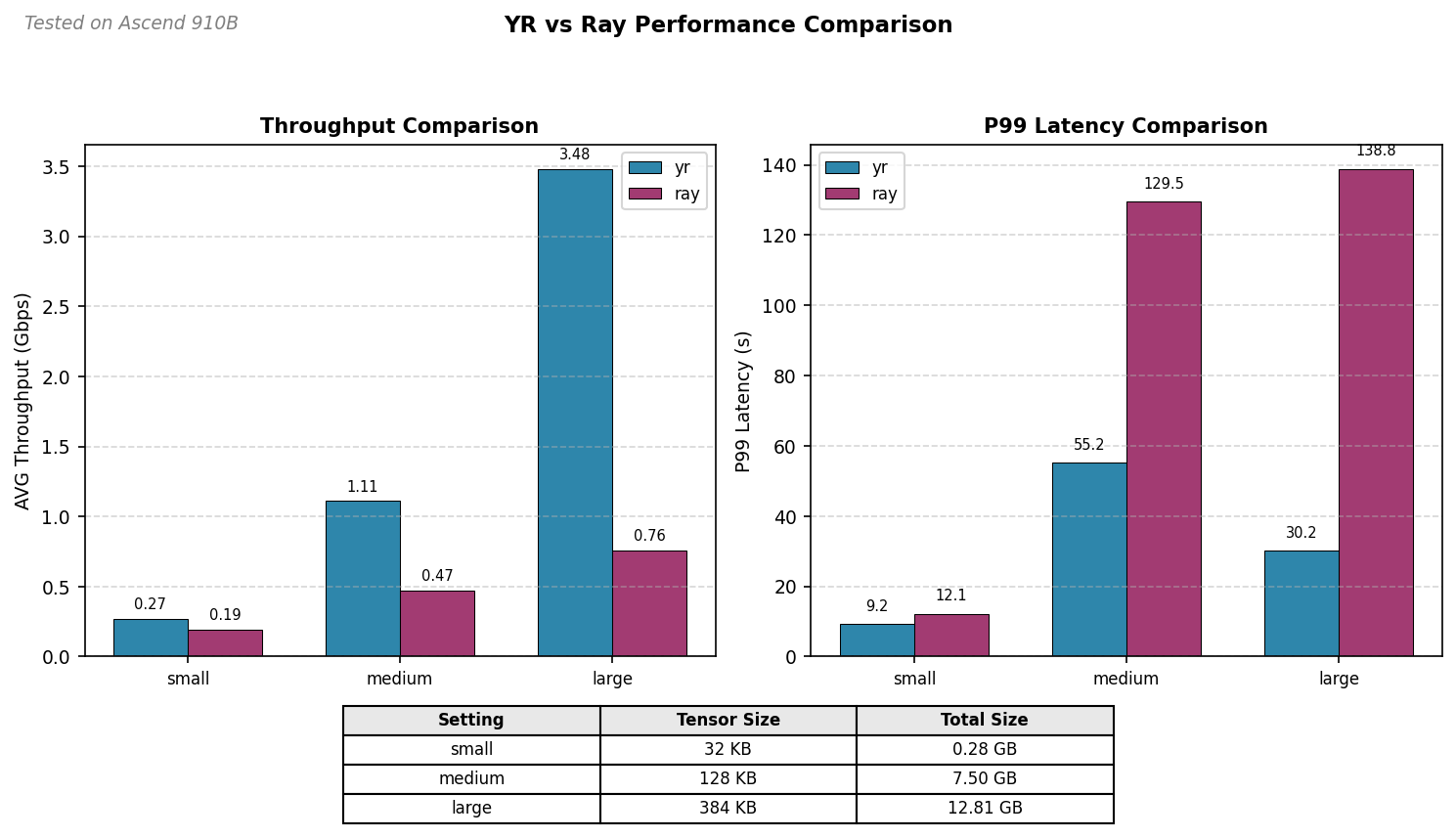
Performance Highlights
- Throughput: YR RDT achieves 2-6x higher throughput than Ray serialization across all tensor sizes, with the gap widening as data size increases.
- Latency: YR RDT reduces latency by 40-80% compared to Ray serialization, particularly significant for medium and large tensor sizes.
- Scaling: Both modes show similar relative performance, with YR RDT maintaining its advantage in distributed (remote) scenarios.
Observations
The fragmented tensor transmission pattern in this test limits Yuanrong Direct Transport's full potential. As shown in the tables, system throughput increases significantly with larger tensor sizes. Under similar Ascend 910B test conditions, transmitting single tensors larger than 10 MB achieves throughput of 50-100 Gbps, indicating Yuanrong Direct Transport performs optimally with larger, contiguous data transfers.
2. Weight Synchronization (P2P Transfer)
Status: Work in Progress
This section will be updated with benchmark results after testing is complete.
2.1 Test Scenario
Use Case: Synchronizing model weights between training and inference instances in a training-inference co-located deployment.
2.2 Planned Tests
2.3 Results
TBD after testing
3. Conclusions
Key Findings
- YR RDT significantly outperforms Ray serialization for NPU tensor transmission, achieving 2-6x higher throughput and 40-80% lower latency across all tested configurations.
- The performance advantage scales with data size - larger tensors benefit more from YR RDT's zero-copy transfer mechanism.
- Weight synchronization benchmarks are pending and will be documented upon completion.
Recommendations
- When to use YR RDT vs Ray serialization
- Optimal configurations for different scenarios
Appendix
Test Reproduction
# RL Samples Transmission Test
python tests/benchmarks/direct_transport_perftest.py \
  --config-file tests/benchmarks/direct_transport_config.yaml
Configuration Files
- Local mode configuration:
Base config for single-node testing. Set
placement: localand adjusttensor_size_kb,count,warmup_timesas needed. - Remote mode configuration:
For distributed testing across two nodes. Set
placement: remoteand configurehead_node_ipandworker_node_ipwith actual IP addresses.